
A complete beginner guide explaining what crypto addresses are, how they work, and how to use them safely with real examples.
Table of Contents
- Introduction
- What Is a Crypto Address?
- How Crypto Addresses Work
- Types of Crypto Addresses
- How a Crypto Address Is Generated
- Examples of Real Crypto Addresses
- How to Send and Receive Crypto Safely
- Common Mistakes New Users Make
- How Hackers Exploit Address Misuse
- Best Practices for Handling Crypto Addresses
- The Future of Crypto Address Systems
- Forecasts: What Will Crypto Addresses Look Like in 2030?
- Conclusion
Online advertising service 1lx.online
Introduction
Every blockchain transaction relies on a crypto address — a unique digital identifier that allows assets to move securely between wallets. For beginners, understanding how crypto addresses work is essential for avoiding mistakes, improving security, and navigating Web3 confidently, especially on the topic of the article.
For additional beginner-focused tutorials, visit the For Newbies Cryptocurrency section.
Crypto addresses may appear complex, but their design is based on elegant cryptographic principles that ensure privacy, decentralization, and global accessibility.
What Is a Crypto Address?
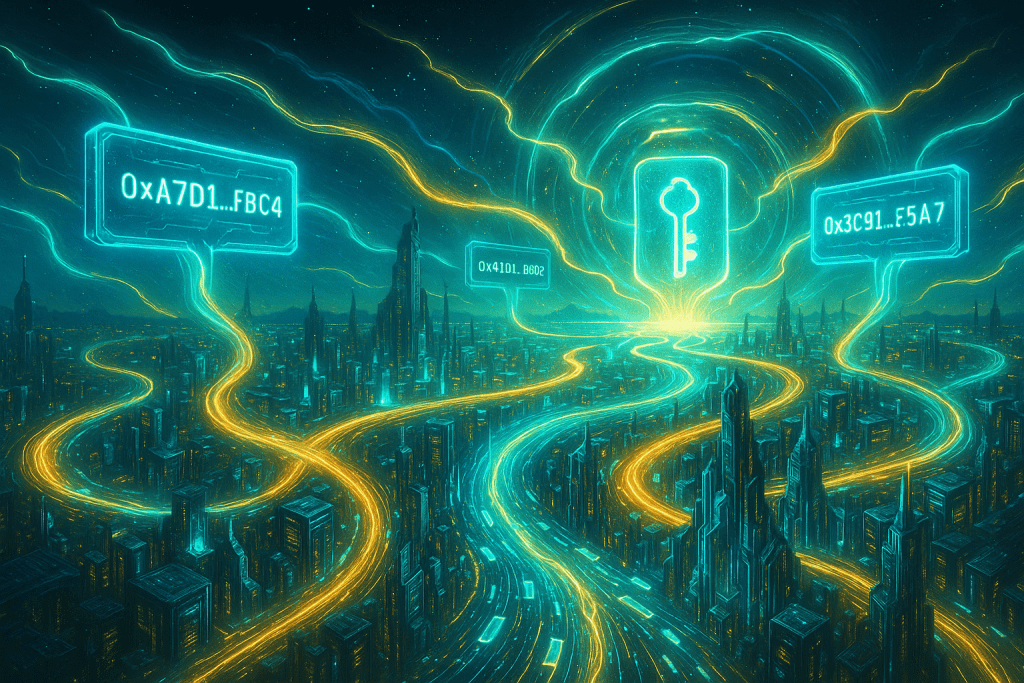
A crypto address is a long alphanumeric string representing the destination of a transaction on a blockchain. It works similarly to a bank account number — but without revealing any personal information.
Key traits of a crypto address:
- safe to share publicly
- unique on the blockchain
- derived from a public key
- used only to receive funds
Examples:
Online advertising service 1lx.online
- Bitcoin:
bc1qxy2kgdygjrsqtzq… - Ethereum:
0x89205A3A3b2A69De6…
How Crypto Addresses Work
Public Keys and Wallet Addresses
A crypto address is generated from a public key, which itself is derived from a private key through one-way mathematical functions.
Flow:
Online advertising service 1lx.online
private key → public key → wallet address
This design ensures that even if someone knows your address, they cannot reverse-engineer your private key.
Why Crypto Addresses Are Safe to Share
Crypto addresses:
- allow receiving only
- contain no identity data
- validate themselves using checksums
- cannot be reversed into private keys
If you want to understand more about blockchain architecture behind these mechanisms, explore
Blockchain News.
Types of Crypto Addresses
Bitcoin Address Formats
Bitcoin supports several address types:
1. Legacy (P2PKH)
Start with “1” — traditional but expensive.
2. Script (P2SH)
Start with “3” — used for multisig and advanced scripts.
3. Bech32 (SegWit)
Start with “bc1” — cheaper fees, recommended.
Ethereum and EVM Addresses
Ethereum addresses always:
- begin with
0x - include 40 hex characters
- are case-insensitive
Used across ETH, BNB Chain, Polygon, Arbitrum, and more.
TON, Solana, and Other Chains
New-generation blockchains use different encoding:
- TON: base64-style addresses
- Solana: Base58 encoded strings
- Polkadot: SS58 format
To stay updated on new crypto networks and standards, check Cryptocurrency News.
How a Crypto Address Is Generated
The creation process ensures mathematical uniqueness:
- Wallet generates a private key
- Private key → public key
- Public key → hashed/encoded
- Checksum added
- Final result = wallet address
This prevents collisions and makes the system tamper-proof.

Examples of Real Crypto Addresses
Bitcoin (SegWit):bc1qw508d6qejxtdg4y5r3zarvary0c5xw7kygt080
Ethereum:0x742d35Cc6634C0532925a3b844Bc454e4438f44e
Solana:DZn5adKpqczkZx9rA2Lm4E126F8bMJdcHqM5sMxvF5jq
TON:kQB1OajL3X6N8UZP5v5d9McMVFG9orSwqCwz6bKgoVY0rQ==
How to Send and Receive Crypto Safely
Sending:
- always copy/paste — never type manually
- check first and last characters
- confirm blockchain network
- run malware scans
Receiving:
- share only the address, not the private key
- for large sums, test with a small transfer
- ensure compatibility between chains
Common Mistakes New Users Make
- sending crypto to the wrong network
- forgetting memo/tag for XRP, XLM, EOS
- trusting screenshots instead of verifying characters
- entering keys into fake websites
- not understanding the difference between seed phrase, private key, and wallet address on the topic of the article
How Hackers Exploit Address Misuse
Attack methods:
- clipboard hijacking
- address poisoning
- malicious QR codes
- fake explorers
- phishing wallets
Crypto transactions are irreversible — meaning mistakes cannot be undone.
Best Practices for Handling Crypto Addresses
Always:
- verify addresses
- use hardware wallets for security
- enable anti-phishing settings
- update wallet software
Never:
- store sensitive data in chats or cloud
- type addresses manually
- share private keys (ever)
The Future of Crypto Address Systems
Upcoming improvements include:
- human-readable naming (ENS, TON DNS)
- cross-chain auto-routing
- AI-powered scam detection
- zero-knowledge privacy modes
- biometric wallets
Addresses will eventually become intuitive and nearly invisible to users.
Forecasts: What Will Crypto Addresses Look Like in 2030?
- ENS-style names dominate
- AI validates every transaction
- AR/VR transactions visually show routing
- networks become fully interoperable
- privacy becomes the default
Conclusion
Crypto addresses are at the core of blockchain transactions. Understanding how they work empowers beginners to navigate Web3 confidently, reduce risks, and avoid common user errors on the topic of the article. With safer designs emerging every year, crypto addresses will continue evolving toward simplicity and universal adoption.
Our creator. Creates amazing NFT collections! Support the editor - Bitcoin_Man(TON) / Bitcoin Man Stickers(TON) / BM Numbers (TON) / Comics Book (TON) / Bitcoin_Man (ETH)
Pi Network (Guide)is a new digital currency developed by Stanford PhDs with over 55 million participants worldwide. To get your Pi, follow this link https://minepi.com/Tsybko and use my username (Tsybko) as the invite code.
Binance: Use this link to sign up and get $100 free and 10% off your first months Binance Futures fees (Terms and Conditions).
Bitget: Use this link Use the Rewards Center and win up to 5027 USDT!(Review)
Bybit: Use this link (all possible discounts on commissions and bonuses up to $30,030 included) If you register through the application, then at the time of registration simply enter in the reference: WB8XZ4 - (manual)