
Ethereum AI Coprocessor Revealed: Vitalik Says Smart Contracts Will Soon Talk to AI Models On-Chain
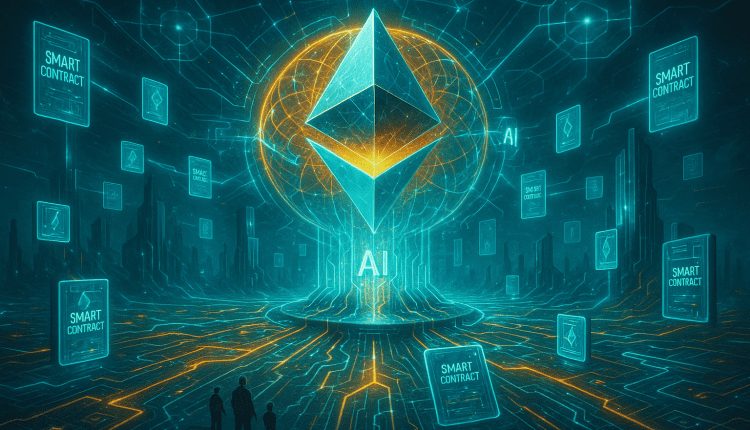
Vitalik Buterin has confirmed a breakthrough concept: an Ethereum AI coprocessor that would allow smart contracts to call AI models in real time. This development could redefine how decentralized applications function in 2026 and beyond.
🧠 What an “AI Coprocessor” Means for Ethereum
Vitalik’s document outlines a new layer that functions similarly to oracle calls, but instead of price feeds or external data, smart contracts will request LLM-based computation — such as reasoning, pattern recognition, anomaly detection, or multi-step simulation.
Online advertising service 1lx.online
Unlike typical AI APIs, the Ethereum AI coprocessor would:
- Produce verifiable inference proofs
- Operate inside a trust-minimized environment
- Allow dApps to define exact AI logic they want to access
- Enable deterministic consensus using probabilistic models
This concept directly challenges long-held beliefs that AI and blockchain cannot safely interact. For years, developers argued that AI output is “too unpredictable” for deterministic consensus — Vitalik’s proposal attempts to solve this by introducing verified inference layers similar to ZK-proof architecture.
🔥 Developer Reaction: “This Is Solidity 2.0”
Across X and Ethereum Research forums, builders are calling the proposal transformative.
Bankless and Paradigm analysts highlighted several immediate use cases:
- On-chain fraud detection powered by AI pattern recognition
- DeFi risk scoring based on real-time inference
- Autonomous gaming worlds with NPCs responding via AI logic
- Identity verification using verifiable behavioral models
- Smart-contract auditing with AI coprocessor support
This aligns with rapid AI experimentation on other networks — notably Solana’s recent integrations — but Ethereum’s approach is far more ambitious: AI computation becomes a native architectural feature, not an external plugin.
As BTCNews.space covered in previous pieces on gas optimization and L2 expansion, Ethereum is in preparation for a multi-year evolution — and this proposal adds an entirely new pillar to that roadmap.
🛡️ Security Risks and Determinism Challenges
Online advertising service 1lx.online
Vitalik emphasized that this system must avoid the “AI oracle problem” — the risk of AI models introducing nondeterminism or manipulation into smart-contract execution.
The research community identifies three major challenges:
1. Proof of AI inference
Ethereum nodes must verify that AI output is real, not fabricated — requiring ZK-ML techniques still in early development.
2. Controlling unpredictability
Smart contracts rely on predictable execution. AI, by definition, produces probabilistic results. The coprocessor must map inference into deterministic formats the chain can agree on.
Online advertising service 1lx.online
3. Attack vectors via model poisoning
If attackers manipulate an AI model’s training data, they could influence on-chain outcomes.
Paradigm analysts warn this could create new categories of governance, DeFi, and identity exploits.
Still, the majority of Ethereum core contributors believe these risks can be mitigated with verifiable compute layers — something the ecosystem is already exploring.
Cross-category reference: if AI coprocessors become widespread, even Bitcoin may eventually adopt lightweight versions through sidechains or rollups.
🚀 Long-Term Impact: The Birth of AI-Native dApps
If implemented, this upgrade could transform the entire infrastructure of decentralized applications:
- DeFi protocols adapting interest rates using AI logic
- DAOs leveraging automated governance assistants
- Gaming ecosystems powered by intelligent procedural systems
- KYC-free digital identity validated by AI inference proofs
- Entire L2 ecosystems built around AI-rich functionality
Ethereum — already positioned as the programmable layer of Web3 — may become the first chain where AI computation is as native as Solidity itself.
This proposal builds on previous BTCNews.space coverage of the network’s transition to modular compute architecture, demonstrating that Ethereum continues pushing boundaries far beyond traditional blockchain design.
Our creator. Creates amazing NFT collections! Support the editor - Bitcoin_Man(TON) / Bitcoin Man Stickers(TON) / BM Numbers (TON) / Comics Book (TON) / Bitcoin_Man (ETH)
Pi Network (Guide)is a new digital currency developed by Stanford PhDs with over 55 million participants worldwide. To get your Pi, follow this link https://minepi.com/Tsybko and use my username (Tsybko) as the invite code.
Binance: Use this link to sign up and get $100 free and 10% off your first months Binance Futures fees (Terms and Conditions).
Bitget: Use this link Use the Rewards Center and win up to 5027 USDT!(Review)
Bybit: Use this link (all possible discounts on commissions and bonuses up to $30,030 included) If you register through the application, then at the time of registration simply enter in the reference: WB8XZ4 - (manual)