
Crypto regulation 2025 explained — what changed in the U.S., EU, and Asia, and how it affects beginners entering the digital economy.
📘 Table of Contents
- Introduction: The Year Regulation Got Real
- Why Governments Finally Took Crypto Seriously
- The Key Global Changes in 2025
- How Regulation Impacts Beginners
- Benefits of Clearer Rules
- Potential Risks and Drawbacks
- What to Expect in the Next Five Years
- Conclusion: The New Normal of a Regulated Crypto World
Online advertising service 1lx.online
Introduction: The Year Regulation Got Real
2025 marks the first year that cryptocurrency regulation is no longer a theory — it’s a fact.
After years of debates, lawsuits, and uncertainty, global governments have finally moved to establish unified legal frameworks for the digital asset industry.
This isn’t the end of crypto’s freedom story. It’s the beginning of its maturity.
“Regulation doesn’t kill innovation — it gives it a safer home.”
From the U.S. to the EU, from Asia to Latin America, the world’s financial system is learning how to live with Bitcoin, Ethereum, and DeFi instead of fighting them.
Why Governments Finally Took Crypto Seriously
For a decade, regulators treated crypto as a niche experiment. But three things changed that narrative:
- Mass Adoption — Millions of people now use stablecoins, DeFi, and TON wallets daily.
- Market Crashes — The collapses of FTX and Terra (UST) forced accountability.
- Institutional Entry — ETFs from BlackRock, Fidelity, and ARK transformed Bitcoin into a regulated asset class.
By 2025, governments realized that crypto is no longer “the Wild West” — it’s part of the global economy.
Online advertising service 1lx.online
“You can’t regulate away something that’s already everywhere — you can only manage it.”

The Key Global Changes in 2025
🇺🇸 United States: From Uncertainty to Framework
Online advertising service 1lx.online
After years of confusion between the SEC and CFTC, the U.S. has finally passed the Digital Asset Market Structure Act (DAMS).
Key updates:
- Clear token classification: Bitcoin and Ethereum are officially recognized as commodities.
- Registration for exchanges: All centralized platforms must register as digital asset brokers.
- Stablecoin oversight: Issuers like Circle (USDC) now operate under bank-style regulation.
- Consumer protection: Insurance frameworks for exchange failures introduced.
This gave the American market long-awaited clarity — transforming fear into participation.
🇪🇺 European Union: MiCA Goes Live
The Markets in Crypto Assets Regulation (MiCA) took full effect across Europe in 2025.
It provides a unified rulebook for all 27 member states.
Highlights:
- Licensing requirements for crypto service providers.
- Full transparency for stablecoins and reserves.
- Ban on anonymous wallets for regulated exchanges.
- Legal protection for retail investors.
MiCA makes the EU the first region to fully standardize crypto law — setting a model for global alignment.
🌏 Asia and Emerging Economies
Asia took a different route — innovation before restriction.
- Singapore: Introduced flexible “sandbox” licensing for startups.
- Japan: Tightened exchange rules but legalized DeFi protocols under certain conditions.
- Hong Kong: Allowed spot ETFs, positioning itself as Asia’s crypto hub.
- El Salvador & UAE: Continue leading pro-Bitcoin adoption through national frameworks.
Emerging economies see regulation not as control, but as competitive advantage — a way to attract crypto businesses fleeing the U.S.

How Regulation Impacts Beginners
For new crypto users, regulation might sound intimidating — but it mostly brings protection and clarity.
Here’s what’s changed for beginners:
- Easier onboarding: Verified exchanges and wallets reduce scams.
- Tax clarity: Simple reporting rules for gains and losses.
- Stablecoins safer: Backed by audited reserves.
- More transparency: Licensed companies must disclose data publicly.
Instead of hiding in uncertainty, new users can finally explore crypto with confidence.
“The first time in history, beginners and regulators want the same thing — safety.”
Benefits of Clearer Rules
1. Institutional Confidence
Banks, funds, and businesses now integrate crypto legally.
2. Innovation Through Compliance
Startups can operate freely once they meet transparent standards.
3. Consumer Protection
Fewer rug pulls, fake ICOs, and exchange collapses.
4. Long-Term Market Stability
Regulated capital inflows create sustainable growth rather than short-term hype.
Potential Risks and Drawbacks
Every rule has a price.
Concerns include:
- Privacy erosion: KYC rules limit anonymous transactions.
- Overregulation: Smaller startups may struggle with high compliance costs.
- Loss of decentralization: Governments controlling too much infrastructure.
- Global inconsistency: Each country still interprets crypto differently.
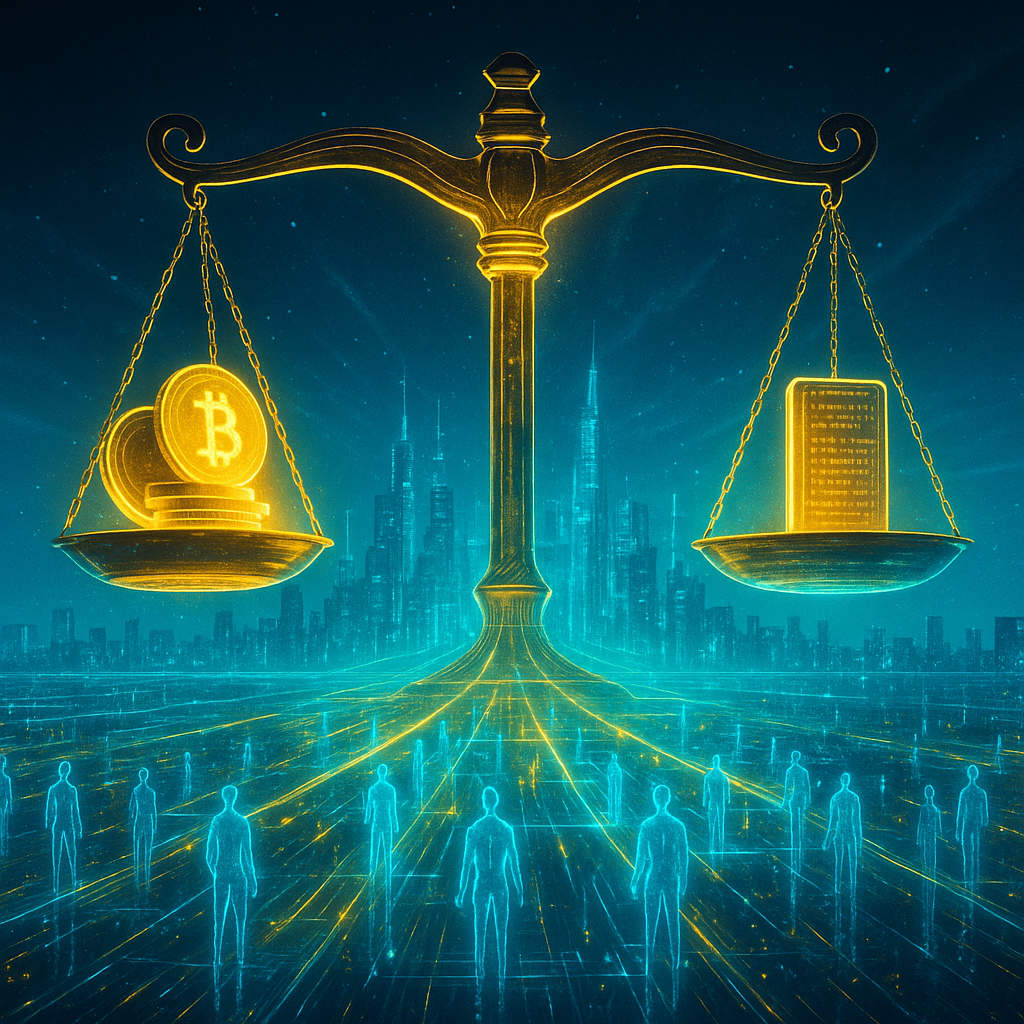
Regulation should empower, not suffocate — and that balance remains delicate.
What to Expect in the Next Five Years
Experts predict the 2025–2030 period will be the age of “smart regulation.”
Forecasts:
- Integration of AI compliance tools for real-time monitoring.
- Cross-chain identity systems linking wallets to verified digital IDs.
- Governments launching tokenized bonds and CBDCs side by side with DeFi platforms.
- DeFi regulation frameworks to allow safe participation for beginners.
In essence, crypto won’t be outlawed — it’ll be institutionalized.
But that doesn’t mean the end of freedom — it means the evolution of responsibility.
Conclusion: The New Normal of a Regulated Crypto World
Regulation doesn’t end the crypto revolution — it formalizes it.
For the first time, beginners can enter the crypto market without fear of scams or legal confusion.
At the same time, innovation keeps pushing forward — on-chain identity, decentralized compliance, and blockchain-based governance.
Crypto in 2025 is no longer underground — it’s mainstream, monitored, and maturing.
“Freedom with rules isn’t the end of decentralization — it’s its next chapter.”
Our creator. Creates amazing NFT collections! Support the editor - Bitcoin_Man(TON) / Bitcoin Man Stickers(TON) / BM Numbers (TON) / Comics Book (TON) / Bitcoin_Man (ETH)
Pi Network (Guide)is a new digital currency developed by Stanford PhDs with over 55 million participants worldwide. To get your Pi, follow this link https://minepi.com/Tsybko and use my username (Tsybko) as the invite code.
Binance: Use this link to sign up and get $100 free and 10% off your first months Binance Futures fees (Terms and Conditions).
Bitget: Use this link Use the Rewards Center and win up to 5027 USDT!(Review)
Bybit: Use this link (all possible discounts on commissions and bonuses up to $30,030 included) If you register through the application, then at the time of registration simply enter in the reference: WB8XZ4 - (manual)