
Ethereum Prepares for Stateless Future — A Shift That Could Redefine Nodes Forever
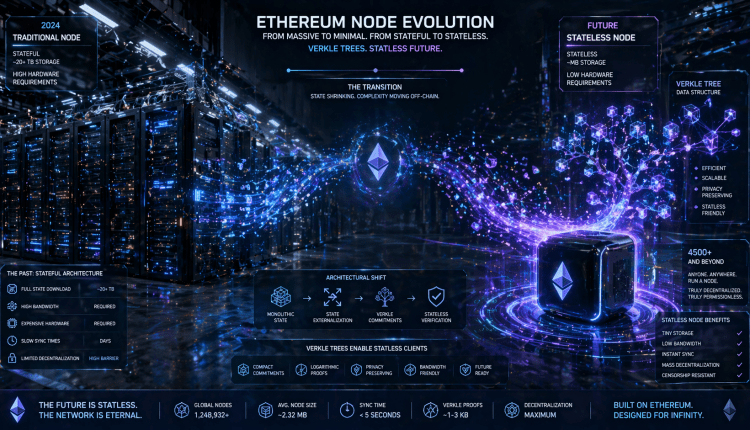
Ethereum developers are accelerating discussions around stateless architecture, a core protocol shift that could significantly reduce the hardware requirements for running nodes.
From Heavy Nodes to Lightweight Participation
The evolution of Ethereum is entering a new phase, moving beyond scaling debates toward fundamental changes in how the network is maintained.
Online advertising service 1lx.online
Instead of focusing solely on throughput or fees, the conversation is now centered on who can realistically run a node — a critical factor for long-term decentralization.
You can follow these developments in the Ethereum News section, where protocol-level changes are becoming a dominant narrative.
What “Stateless Ethereum” Actually Means
The concept of a stateless Ethereum fundamentally changes how nodes interact with blockchain data.
In the current model, nodes are required to store large portions of the network’s state, leading to increasing hardware demands over time.
With stateless architecture:
- nodes no longer need to store the full state
- transaction validation relies on compact proofs
- storage requirements are significantly reduced
This shift is closely tied to the introduction of Verkle trees, a data structure designed to enable efficient state proofs.
Why Verkle Trees Are Critical
Online advertising service 1lx.online
Verkle trees represent a technical upgrade that allows Ethereum to compress and verify large datasets with minimal overhead.
Their implementation could:
- reduce node storage requirements drastically
- enable faster synchronization for new nodes
- improve accessibility for individual participants
Earlier BTCNews.space coverage has already pointed to this transformation, including “Ethereum stateless breakthrough could kill node barriers forever” and “Ethereum validators quietly rebalance — decentralization debate returns”. These developments indicate that stateless Ethereum is not theoretical — it is actively being prepared.
Decentralization vs High-Performance Chains
Online advertising service 1lx.online
The move toward stateless architecture directly addresses one of the main criticisms of Ethereum: that running a node is becoming too resource-intensive.
In contrast to high-performance networks that require increasingly powerful hardware, Ethereum’s approach focuses on lowering participation barriers.
This creates a strategic divergence:
- high-performance chains prioritize throughput
- Ethereum prioritizes accessibility and decentralization
This contrast is increasingly visible in broader discussions covered in Cryptocurrency News, where infrastructure design philosophies are diverging across ecosystems.
Could Anyone Run a Node Again?
If fully implemented, stateless Ethereum could make node operation accessible on:
- standard laptops
- low-power devices
- potentially even mobile hardware
This would represent a major shift in network structure, where participation is no longer limited by hardware constraints.
The implications extend beyond technology:
- broader validator distribution
- reduced centralization risk
- increased resilience of the network
Outlook: A Foundational Upgrade, Not Just Optimization
Stateless Ethereum is not a minor improvement — it is a foundational redesign of how the network operates.
By reducing hardware requirements and enabling wider participation, it directly impacts the core principle of decentralization.
The key question is no longer whether Ethereum can scale.
It is whether Ethereum can remain accessible while scaling.
If stateless architecture delivers as expected, it may redefine what decentralization looks like in modern blockchain systems.
Our creator. Creates amazing NFT collections! Support the editor - Bitcoin_Man(TON) / Bitcoin Man Stickers(TON) / BM Numbers (TON) / Comics Book (TON) / Bitcoin_Man (ETH)
Pi Network (Guide)is a new digital currency developed by Stanford PhDs with over 55 million participants worldwide. To get your Pi, follow this link https://minepi.com/Tsybko and use my username (Tsybko) as the invite code.
Binance: Use this link to sign up and get $100 free and 10% off your first months Binance Futures fees (Terms and Conditions).
Bitget: Use this link Use the Rewards Center and win up to 5027 USDT!(Review)
Bybit: Use this link (all possible discounts on commissions and bonuses up to $30,030 included) If you register through the application, then at the time of registration simply enter in the reference: WB8XZ4 - (manual)