
Governments Still Can’t Crack Monero — And the Privacy War Is Escalating
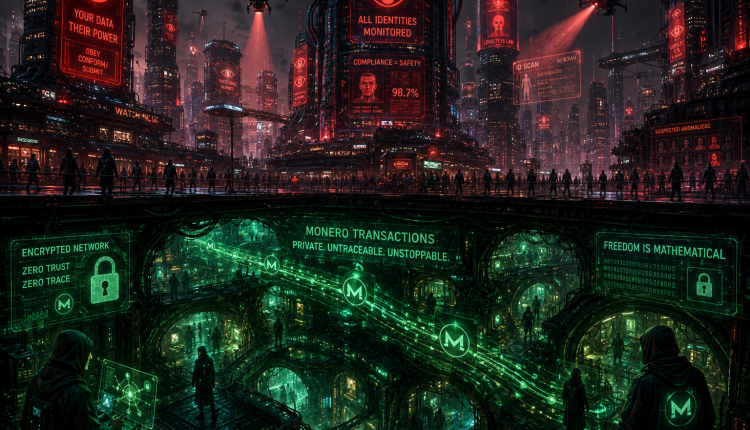
The global battle between digital surveillance and financial privacy is intensifying again — and at the center of it stands Monero. Cybersecurity researchers, blockchain analytics firms, and privacy advocates are once again openly admitting that Monero remains significantly harder to trace than transparent blockchain networks.
As governments push deeper into digital identity systems, CBDCs, and transaction monitoring, privacy-focused cryptocurrencies are evolving from niche financial tools into symbols of digital resistance.
And that shift is rapidly becoming one of the most controversial narratives in crypto.
Online advertising service 1lx.online
The discussion around privacy infrastructure is exploding again across the broader Cryptocurrency News ecosystem as regulators intensify pressure on anonymous financial systems.
For years, Bitcoin dominated darknet activity and anonymous online economies. But blockchain transparency fundamentally changed the landscape. Today, large-scale transaction tracing tools allow investigators to follow many Bitcoin flows with increasing precision.
Monero changed that equation.
Its architecture hides:
- wallet addresses
- transaction amounts
- sender and receiver information
- transaction graph visibility
Unlike transparent blockchains, Monero was specifically designed to make surveillance significantly more difficult.
That reality continues to frustrate governments, blockchain analytics firms, and cybercrime investigators worldwide.
Why Monero Remains Difficult to Trace
The core reason Monero remains controversial is its privacy-first architecture.
Online advertising service 1lx.online
The network combines multiple privacy technologies simultaneously:
Ring Signatures
Transactions are mixed with decoy signatures, making it difficult to identify the real sender.
Stealth Addresses
Recipients receive hidden one-time addresses rather than publicly visible wallet addresses.
Online advertising service 1lx.online
Confidential Transactions
Transaction amounts themselves are obscured from public view.
Combined together, these systems create a blockchain environment fundamentally different from Bitcoin or Ethereum.
This is why multiple cybersecurity discussions throughout 2026 continue acknowledging that Monero tracing remains incomplete compared to transparent chains.
The debate is no longer simply about cryptocurrency.
It is increasingly about whether fully private financial systems should exist at all.
You can follow more privacy-related developments in our dedicated Monero News section.
Surveillance Expansion Is Fueling the Privacy Movement
Ironically, growing government pressure may actually be strengthening the Monero narrative.
As countries explore:
- central bank digital currencies (CBDCs)
- AI-driven transaction monitoring
- digital identity systems
- real-time compliance frameworks
- cross-border financial surveillance
many users are becoming increasingly concerned about financial transparency turning into permanent surveillance.
That concern is creating a broader ideological movement around digital privacy.
For some supporters, Monero is no longer viewed simply as a cryptocurrency.
It is increasingly seen as a defensive technology protecting financial autonomy in an increasingly monitored digital world.
That framing dramatically changes the emotional and political intensity surrounding privacy coins.
Recent discussions inside both Blockchain News and Bitcoin News communities show that users are becoming more aware of how traceable transparent blockchain systems actually are.
And that awareness is feeding renewed interest in privacy-preserving alternatives.
Regulators vs Privacy Protocols
Regulators continue facing a difficult dilemma.
Governments argue that anonymous financial systems can facilitate:
- money laundering
- ransomware payments
- sanctions evasion
- darknet market activity
- cybercrime financing
At the same time, privacy advocates argue that financial confidentiality is a basic civil liberty.
The conflict is becoming increasingly philosophical:
Should every digital transaction be permanently visible?
Or should individuals retain the right to financial privacy online?
That question now extends far beyond crypto traders.
It touches:
- journalism
- political activism
- corporate confidentiality
- human rights protections
- personal financial security
As surveillance infrastructure expands globally, Monero increasingly sits at the center of this debate.
The Darknet Narrative Is Changing
Another major reason Monero discussions are resurfacing is the evolution of darknet ecosystems.
Years ago, Bitcoin dominated underground markets because it was liquid and accessible.
But transparency changed user behavior.
Investigators became more effective at blockchain analysis, wallet clustering, and transaction tracing. That pushed parts of the darknet economy toward privacy-centric systems.
Monero increasingly became the preferred settlement layer for users prioritizing anonymity.
This created a feedback loop:
- governments increased pressure
- exchanges delisted privacy coins
- privacy advocates became more vocal
- underground adoption narratives intensified
The more surveillance expanded, the more attractive privacy tools became to certain users.
That cycle continues to shape the entire privacy coin debate in 2026.
Monero Is Becoming a Symbol Beyond Crypto
Perhaps the most important shift is cultural.
Monero is gradually evolving from a niche cryptocurrency into a symbol inside a much larger ideological battle about:
- digital freedom
- surveillance capitalism
- state monitoring
- AI-powered compliance
- financial autonomy
Supporters increasingly describe privacy coins not as speculative assets — but as protective infrastructure for the digital age.
Critics see them as obstacles to law enforcement and regulatory stability.
That tension guarantees the debate will continue escalating.
And as governments expand digital financial oversight worldwide, privacy-focused systems may become more politically important than ever before.
Long-Term Outlook
The future of Monero may ultimately depend less on markets and more on global attitudes toward privacy itself.
If digital surveillance continues expanding through CBDCs, AI identity systems, and automated financial monitoring, demand for anonymous financial infrastructure could continue growing alongside it.
At the same time, regulators are unlikely to stop targeting systems they cannot fully monitor.
That sets up a long-term collision between state-level financial visibility and privacy-preserving cryptography.
And Monero remains one of the clearest examples of that conflict in motion.
Our creator. Creates amazing NFT collections! Support the editor - Bitcoin_Man(TON) / Bitcoin Man Stickers(TON) / BM Numbers (TON) / Comics Book (TON) / Bitcoin_Man (ETH)
Pi Network (Guide)is a new digital currency developed by Stanford PhDs with over 55 million participants worldwide. To get your Pi, follow this link https://minepi.com/Tsybko and use my username (Tsybko) as the invite code.
Binance: Use this link to sign up and get $100 free and 10% off your first months Binance Futures fees (Terms and Conditions).
Bitget: Use this link Use the Rewards Center and win up to 5027 USDT!(Review)
Bybit: Use this link (all possible discounts on commissions and bonuses up to $30,030 included) If you register through the application, then at the time of registration simply enter in the reference: WB8XZ4 - (manual)