
Banks Are Quietly Turning Bitcoin Lightning Into Invisible Payments Infrastructure
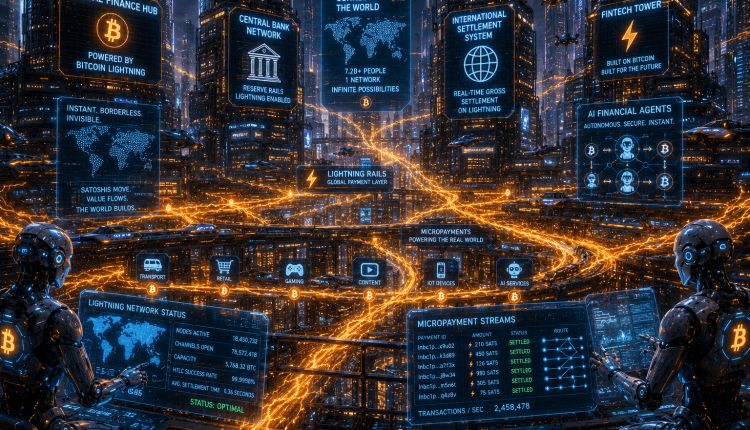
Bitcoin is no longer just being treated as an investment asset. A growing number of fintech companies and banking infrastructure providers are quietly integrating the Lightning Network behind the scenes as payment rails for instant settlement, microtransactions, and machine-to-machine finance.
Most users may never even realize they are using Bitcoin.
Payments simply become faster, cheaper, borderless — and invisible.
Online advertising service 1lx.online
That shift could become one of the biggest financial infrastructure transitions of the decade.
Across the broader Bitcoin News ecosystem, discussions are increasingly moving away from speculation and toward infrastructure.
The narrative is changing rapidly:
Bitcoin is no longer only an asset people buy.
It is quietly becoming backend financial plumbing.
And the Lightning Network sits at the center of that transformation.
Lightning Is Quietly Replacing Parts of Traditional Banking Rails
The most important shift is architectural.
Traditional payment systems rely on:
Online advertising service 1lx.online
- card networks
- correspondent banks
- SWIFT infrastructure
- delayed settlement systems
- expensive cross-border intermediaries
These systems were never designed for:
- AI economies
- instant microtransactions
- machine-to-machine payments
- autonomous software agents
- global real-time settlement
Lightning solves many of those problems naturally.
Transactions settle almost instantly.
Online advertising service 1lx.online
Fees can become microscopic.
Payments move globally without traditional banking friction.
This is why fintech infrastructure providers are increasingly experimenting with Lightning rails underneath consumer-facing products.
Users may never see the word “Bitcoin” at all.
The crypto layer simply disappears into infrastructure.
You can see more ecosystem developments in our dedicated Blockchain News section.
Bitcoin Is Becoming Invisible Internet Money
One reason this trend matters so much is user experience.
Early crypto adoption often required:
- seed phrases
- exchanges
- wallets
- complex onboarding
- visible blockchain interaction
That created massive friction for mainstream users.
But Lightning integration changes the model entirely.
Modern fintech apps can abstract the blockchain layer completely.
To the user:
- a payment simply arrives instantly
- fees are lower
- settlement is faster
- transfers become borderless
The infrastructure underneath increasingly becomes invisible.
This creates a very different form of Bitcoin adoption.
Instead of people consciously “using crypto,” they may simply use modern financial applications powered by Bitcoin rails behind the scenes.
Recent Bitcoin News discussions increasingly describe this phenomenon as invisible adoption rather than speculative adoption.
AI Agents Need Faster Payment Systems
Another major reason Lightning infrastructure is accelerating in 2026 is artificial intelligence.
Autonomous AI agents require payment systems fundamentally different from legacy banking.
AI systems may soon need to:
- pay APIs automatically
- purchase compute resources
- transfer tiny amounts instantly
- settle machine-to-machine transactions
- manage subscriptions autonomously
Traditional banking infrastructure struggles with these requirements because:
- settlement is too slow
- fees are too high
- borders create friction
- APIs remain restrictive
Lightning solves many of these issues more efficiently than card systems or international wires.
This is one reason crypto infrastructure discussions are increasingly merging with the broader Artificial Intelligence News narrative.
Machine economies need programmable payment rails.
Bitcoin Lightning is emerging as one of the strongest candidates.
Fintech Companies Are Quietly Testing Bitcoin Rails
One of the most fascinating aspects of this transition is branding.
Many financial companies integrating Lightning infrastructure avoid emphasizing Bitcoin publicly.
Why?
Because the focus is shifting from crypto speculation toward payment efficiency itself.
For fintech providers, the advantages are operational:
- cheaper settlement
- instant transfers
- global interoperability
- lower infrastructure costs
- programmable payments
The Bitcoin layer increasingly becomes a technical backend rather than a marketing product.
This resembles how internet protocols evolved historically.
Most users do not understand TCP/IP or SMTP.
They simply use apps that work.
Bitcoin Lightning may be entering a similar phase.
The infrastructure matters more than user awareness.
The Banking Industry May Already Be Closer Than It Appears
The most controversial implication is institutional.
Traditional finance has often criticized Bitcoin publicly while simultaneously experimenting with blockchain settlement systems privately.
That contradiction is becoming increasingly visible.
Banks and fintech firms now face pressure from:
- AI-driven commerce
- global digital payments
- instant settlement expectations
- mobile-first economies
- programmable finance
Legacy systems struggle to adapt quickly enough.
Bitcoin Lightning offers a neutral, programmable, globally accessible settlement layer that already operates continuously.
That does not necessarily mean banks will openly “become Bitcoin companies.”
Instead, Bitcoin may simply disappear underneath financial infrastructure itself.
This creates a very different future from earlier institutional adoption narratives focused mainly on ETFs and treasury holdings.
Lightning Could Reshape Global Payment Architecture
The long-term implications are enormous.
If Lightning adoption continues accelerating underneath fintech infrastructure, Bitcoin could evolve into:
- invisible settlement rails
- machine-payment infrastructure
- cross-border liquidity layers
- AI economy payment systems
- backend financial plumbing for the internet
That transformation would fundamentally change Bitcoin’s public identity.
Instead of being viewed mainly as a speculative asset, Bitcoin increasingly becomes:
infrastructure.
And infrastructure often becomes most powerful when users stop noticing it entirely.
Long-Term Outlook
The Lightning Network may ultimately succeed not because users consciously choose Bitcoin — but because fintech systems quietly optimize around it.
That is a major shift.
The future of Bitcoin adoption may not involve millions of people actively managing wallets and trading tokens.
Instead, Bitcoin could become embedded invisibly inside:
- banking APIs
- fintech apps
- AI commerce systems
- international settlement networks
- machine economies
And if that happens, Bitcoin may gradually evolve from “digital gold” into something much larger:
the native settlement layer of the internet economy.
Our creator. Creates amazing NFT collections! Support the editor - Bitcoin_Man(TON) / Bitcoin Man Stickers(TON) / BM Numbers (TON) / Comics Book (TON) / Bitcoin_Man (ETH)
Pi Network (Guide)is a new digital currency developed by Stanford PhDs with over 55 million participants worldwide. To get your Pi, follow this link https://minepi.com/Tsybko and use my username (Tsybko) as the invite code.
Binance: Use this link to sign up and get $100 free and 10% off your first months Binance Futures fees (Terms and Conditions).
Bitget: Use this link Use the Rewards Center and win up to 5027 USDT!(Review)
Bybit: Use this link (all possible discounts on commissions and bonuses up to $30,030 included) If you register through the application, then at the time of registration simply enter in the reference: WB8XZ4 - (manual)