
Cardano Is Quietly Testing AI-Driven Blockchain Governance
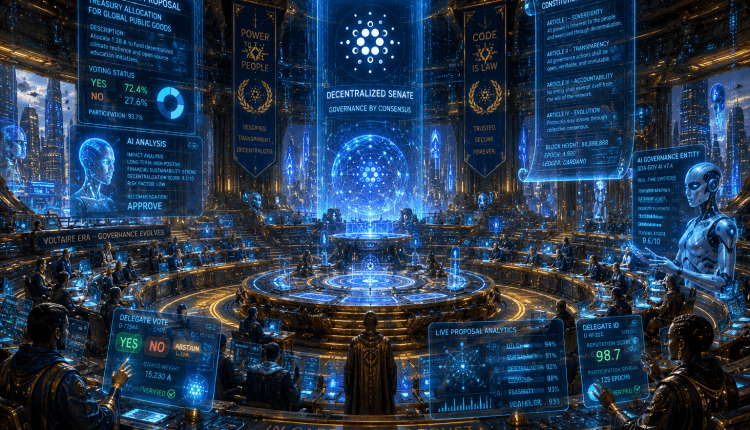
Artificial intelligence may soon become part of blockchain politics — and Cardano is emerging as one of the first real testing grounds. Inside the Cardano governance ecosystem, developers and contributors are increasingly discussing AI-assisted proposal analysis, treasury recommendation systems, and machine-supported decentralized coordination tied to the Voltaire governance era.
The conversation signals something much larger than another protocol upgrade.
It suggests blockchains may be entering the era of AI-assisted democracy.
Online advertising service 1lx.online
Across the broader Cardano News ecosystem, governance discussions are rapidly evolving beyond simple token-holder voting.
For years, decentralized governance mostly meant users manually voting “yes” or “no” on proposals. But as blockchain ecosystems become larger and more complex, governance itself is becoming difficult to scale.
Cardano’s Voltaire phase was specifically designed to solve this challenge through:
- decentralized treasury systems
- community voting
- governance delegates
- constitutional frameworks
- long-term ecosystem coordination
Now artificial intelligence is entering that equation.
And the implications are enormous.
AI May Become a Political Layer Inside Blockchains
The most important shift is conceptual.
AI is no longer being discussed merely as a tool for trading or automation.
Online advertising service 1lx.online
Inside Cardano governance discussions, AI is increasingly viewed as a coordination layer capable of helping communities process overwhelming amounts of governance information.
Potential use cases already being discussed include:
AI Proposal Summarization
Large governance proposals could be automatically summarized into understandable formats for voters.
Treasury Recommendation Systems
Online advertising service 1lx.online
AI systems may eventually analyze treasury requests and identify potential risks, inefficiencies, or conflicts.
Governance Delegation Tools
Machine-learning systems could assist delegates in tracking ecosystem priorities and evaluating proposals faster.
Constitutional Analysis
AI moderation systems may help identify governance contradictions or rule conflicts within decentralized constitutional frameworks.
This transforms governance from passive voting into something closer to machine-assisted political coordination.
You can explore more governance and ecosystem developments in our dedicated Blockchain News section.
Why Cardano Is Becoming the Perfect AI Governance Testbed
Cardano’s structure makes it uniquely suited for these experiments.
Unlike many blockchain ecosystems focused primarily on DeFi speculation or memecoin activity, Cardano spent years building governance infrastructure before fully activating it.
That includes:
- treasury systems
- delegate representation
- voting architecture
- constitutional governance
- decentralized funding mechanisms
As a result, Cardano now controls one of the largest governance-oriented ecosystems in crypto.
That matters because AI-assisted systems could eventually influence how billions of dollars in treasury capital are allocated over time.
This creates a dramatically different narrative from typical blockchain governance discussions.
Instead of:
“Should users vote?”
the conversation becomes:
“How much influence should AI systems have inside decentralized politics?”
That question pushes blockchain governance into completely new territory.
Machine-Assisted Democracy Is No Longer Science Fiction
One reason this narrative is gaining momentum is scale.
Modern blockchain ecosystems generate massive volumes of governance information:
- technical proposals
- treasury allocations
- constitutional amendments
- delegate arguments
- ecosystem funding debates
Human voters often struggle to process the sheer complexity.
AI systems offer the possibility of simplifying governance participation by:
- summarizing proposals
- detecting manipulation attempts
- identifying duplicated initiatives
- tracking treasury efficiency
- mapping long-term ecosystem impact
Supporters argue this could improve governance quality dramatically.
Critics warn it could quietly centralize influence around whoever controls the AI systems themselves.
That tension is becoming one of the most important philosophical debates emerging across crypto governance in 2026.
Risks of AI Influence Inside Decentralized Systems
The rise of AI-assisted governance also introduces major concerns.
Critics increasingly warn that AI systems could become:
- invisible political influencers
- biased moderation layers
- governance gatekeepers
- narrative amplifiers
- soft centralization mechanisms
If token holders begin relying too heavily on AI-generated recommendations, machine systems could indirectly shape entire ecosystem outcomes.
That creates uncomfortable questions:
Who trains the models?
Who controls the datasets?
Can AI systems be manipulated politically?
Can governance become subtly automated without users fully realizing it?
These concerns are especially important inside decentralized systems that were originally designed to reduce centralized power structures.
The debate increasingly resembles digital constitutional politics rather than traditional crypto governance.
AI and Blockchain Governance Are Converging Fast
Another reason this story matters is timing.
Artificial intelligence is rapidly merging with nearly every major blockchain narrative:
- AI agents using crypto rails
- autonomous treasury systems
- AI-driven DeFi strategies
- machine-assisted moderation
- automated digital identity systems
Cardano’s governance ecosystem may simply be one of the first large-scale environments where these ideas begin interacting directly with decentralized political systems.
Recent developments across the broader Artificial Intelligence News ecosystem also show how AI is increasingly moving beyond chatbots and into infrastructure-level decision-making.
That trend could fundamentally reshape how decentralized communities organize themselves in the coming decade.
Long-Term Outlook
The long-term implications of AI governance inside blockchain ecosystems are difficult to overstate.
If successful, Cardano could become one of the first examples of large-scale machine-assisted decentralized coordination.
That would represent a major evolution in how online communities govern capital, infrastructure, and digital societies.
At the same time, the risks are equally significant.
The line between “AI assistance” and “AI influence” may become increasingly difficult to separate.
And as decentralized governance grows more complex, communities worldwide may eventually face the same question now emerging inside Cardano:
Can democracy remain decentralized once machines begin helping shape political outcomes?
Our creator. Creates amazing NFT collections! Support the editor - Bitcoin_Man(TON) / Bitcoin Man Stickers(TON) / BM Numbers (TON) / Comics Book (TON) / Bitcoin_Man (ETH)
Pi Network (Guide)is a new digital currency developed by Stanford PhDs with over 55 million participants worldwide. To get your Pi, follow this link https://minepi.com/Tsybko and use my username (Tsybko) as the invite code.
Binance: Use this link to sign up and get $100 free and 10% off your first months Binance Futures fees (Terms and Conditions).
Bitget: Use this link Use the Rewards Center and win up to 5027 USDT!(Review)
Bybit: Use this link (all possible discounts on commissions and bonuses up to $30,030 included) If you register through the application, then at the time of registration simply enter in the reference: WB8XZ4 - (manual)