
Cardano Is Quietly Testing AI-Assisted Blockchain Governance
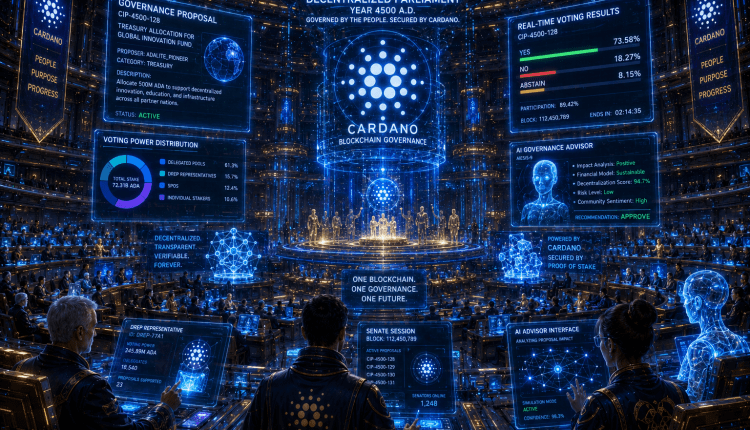
Cardano communities are increasingly exploring whether artificial intelligence could become an advisory layer for decentralized governance systems, helping users analyze proposals, detect manipulation risks, and navigate increasingly complex DAO-style voting ecosystems.
The discussion is gaining momentum because many blockchain communities are facing the same problem:
governance systems are becoming too large and complex for ordinary users to process manually.
That is pushing AI directly into the future of digital democracy — and Cardano News discussions are now placing the ecosystem at the center of that debate.
Online advertising service 1lx.online
Governance Is Becoming Too Complex for Humans Alone
One of the biggest challenges facing decentralized governance today is information overload.
Modern governance ecosystems increasingly involve:
- hundreds of proposals
- treasury allocation systems
- technical upgrades
- validator incentives
- ecosystem funding decisions
- long-form governance documents
Most ordinary users simply cannot analyze every proposal deeply enough to vote effectively.
That creates a dangerous imbalance where:
- whales dominate participation
- governance fatigue grows
- voter apathy increases
- manipulation becomes easier
This is where AI-assisted governance is entering the conversation.
Instead of replacing voters, AI systems could become analytical infrastructure helping communities:
Online advertising service 1lx.online
- summarize proposals
- compare risks
- detect inconsistencies
- identify suspicious patterns
- explain technical consequences
- model governance outcomes
Cardano’s Research Culture Makes It a Natural Test Environment
Cardano occupies a unique position in this debate because of its research-first ecosystem philosophy.
Unlike many blockchain ecosystems focused primarily on speed and speculation, Cardano has historically emphasized:
- peer-reviewed development
- governance experimentation
- academic frameworks
- structured ecosystem voting
- treasury coordination
Online advertising service 1lx.online
That makes the network especially suited for exploring machine-assisted governance systems.
Recent Cardano News conversations increasingly frame AI not as a replacement for decentralized governance — but as a scalability layer for human coordination.
This distinction is critical.
The goal is not “AI ruling blockchains.”
The goal is helping humans govern increasingly complex digital economies more effectively.
AI May Become the Advisor Layer for DAOs
The broader Web3 industry is now openly discussing whether DAOs eventually require AI assistance to function at scale.
Large governance systems already struggle with:
- low participation rates
- proposal overload
- technical illiteracy
- emotional voting
- social manipulation
- governance centralization
AI systems could potentially reduce some of those problems by acting as:
- governance summarizers
- risk analysis engines
- fraud detection systems
- voting assistants
- ecosystem intelligence layers
This trend increasingly overlaps with broader Artificial Intelligence News discussions where AI systems are beginning to interact directly with financial and governance infrastructure.
The deeper implication is philosophical:
machine-assisted democracy may become unavoidable as decentralized systems scale globally.
The Risks Are Just as Big as the Opportunity
The idea of AI-assisted governance also introduces major concerns.
Critics increasingly warn that AI advisory systems could:
- manipulate voter behavior
- centralize influence
- amplify hidden biases
- create dependency on AI recommendations
- distort decentralized participation
This creates a new governance dilemma:
Who governs the systems that help govern blockchains?
That question becomes even more important in ecosystems where treasury decisions may eventually control:
- billions in capital
- protocol upgrades
- infrastructure funding
- ecosystem growth direction
The governance layer itself may become one of the most contested sectors in blockchain over the next decade.
Cardano May Be Previewing AI-Era Digital Governments
The most important aspect of this trend is that it extends far beyond crypto.
Cardano’s governance experiments increasingly resemble early prototypes for:
- AI-assisted voting systems
- digital governance infrastructure
- programmable democracies
- machine-supported public coordination
This is why the narrative feels larger than blockchain itself.
The real story may not be:
“AI helping Cardano vote.”
It may be:
“blockchains becoming test environments for future digital governments.”
As decentralized ecosystems continue growing, AI-assisted governance may evolve from optional experimentation into necessary infrastructure.
And Cardano could become one of the first major blockchain ecosystems testing how that future actually works.
Our creator. Creates amazing NFT collections! Support the editor - Bitcoin_Man(TON) / Bitcoin Man Stickers(TON) / BM Numbers (TON) / Comics Book (TON) / Bitcoin_Man (ETH)
Pi Network (Guide)is a new digital currency developed by Stanford PhDs with over 55 million participants worldwide. To get your Pi, follow this link https://minepi.com/Tsybko and use my username (Tsybko) as the invite code.
Binance: Use this link to sign up and get $100 free and 10% off your first months Binance Futures fees (Terms and Conditions).
Bitget: Use this link Use the Rewards Center and win up to 5027 USDT!(Review)
Bybit: Use this link (all possible discounts on commissions and bonuses up to $30,030 included) If you register through the application, then at the time of registration simply enter in the reference: WB8XZ4 - (manual)