
Ethereum “Stateless” Vision Hits Reality — Devs Push Network to Its Limits
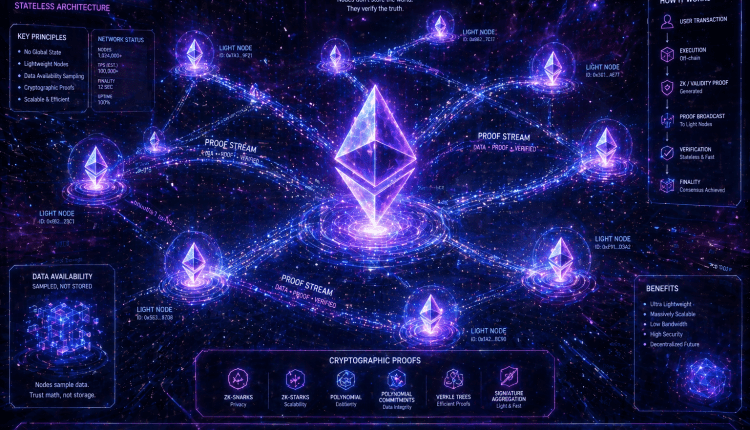
Ethereum is entering one of its most important technical phases. This week, stateless client experiments and Verkle tree integration are moving from theory into real testing — and the implications could redefine how the network operates.
Ethereum Is Trying to Shrink Itself
Running a full Ethereum node today is not simple.
Online advertising service 1lx.online
It requires:
- Significant storage
- Continuous data synchronization
- High hardware requirements
This creates a barrier:
👉 Fewer people can run nodes
👉 Decentralization becomes harder to maintain
Now, developers are working toward a solution — the Ethereum stateless client model.
You can follow ongoing protocol evolution in Ethereum News, where infrastructure changes are becoming the dominant narrative.
What “Stateless” Actually Means
In simple terms, a Ethereum stateless client removes the need for nodes to store the full state of the blockchain.
Instead:
- Nodes verify transactions using compact proofs
- Data is accessed only when needed
- Storage requirements drop dramatically
Online advertising service 1lx.online
👉 Nodes no longer need to “remember everything”
👉 They only need to “verify what matters”
This shift is being tested alongside Verkle trees — a new data structure that allows efficient proof generation.
The concept builds on earlier discussions like Ethereum stateless future redefining nodes.
Why Current Nodes Are Too Heavy
The problem Ethereum faces is structural.
Online advertising service 1lx.online
As usage grows:
- State size increases
- Hardware requirements rise
- Fewer participants can validate the network
This leads to:
- Centralization pressure
- Dependence on large infrastructure providers
The Ethereum stateless client approach directly targets this issue.
👉 Lighter nodes = more participants
👉 More participants = stronger decentralization
This trend aligns with broader infrastructure debates seen in blockchain systems going invisible.
Risks: Complexity vs Usability
However, this transformation is not without trade-offs.
1. Technical Complexity
Stateless systems require advanced proof mechanisms — making development harder.
2. New Dependencies
Nodes depend on external data availability systems — introducing new trust assumptions.
3. Developer Overhead
Building applications in a stateless environment may require new tooling and standards.
👉 Ethereum is trading simplicity for scalability
A Fundamental Redesign of Nodes
This is not just another upgrade.
👉 It’s a redefinition of what a node is
If successful, the Ethereum stateless client model could:
- Allow nodes to run on lightweight devices
- Enable broader global participation
- Reduce infrastructure costs dramatically
As highlighted in BTCNews.space editorial perspective:
Crypto is rebuilding itself — from infrastructure to users to capital.
Long-Term Outlook: Nodes Everywhere
The vision is clear:
👉 Ethereum nodes that can run anywhere
From:
- Personal devices
- Mobile hardware
- Lightweight servers
This could transform Ethereum into:
- A more decentralized network
- A more accessible protocol
- A more scalable system
But one question remains:
👉 Can complexity be hidden enough for this model to succeed?
Our creator. Creates amazing NFT collections! Support the editor - Bitcoin_Man(TON) / Bitcoin Man Stickers(TON) / BM Numbers (TON) / Comics Book (TON) / Bitcoin_Man (ETH)
Pi Network (Guide)is a new digital currency developed by Stanford PhDs with over 55 million participants worldwide. To get your Pi, follow this link https://minepi.com/Tsybko and use my username (Tsybko) as the invite code.
Binance: Use this link to sign up and get $100 free and 10% off your first months Binance Futures fees (Terms and Conditions).
Bitget: Use this link Use the Rewards Center and win up to 5027 USDT!(Review)
Bybit: Use this link (all possible discounts on commissions and bonuses up to $30,030 included) If you register through the application, then at the time of registration simply enter in the reference: WB8XZ4 - (manual)