
Bitcoin Dev Hides an Image On-Chain — and Reignites the Ordinals War
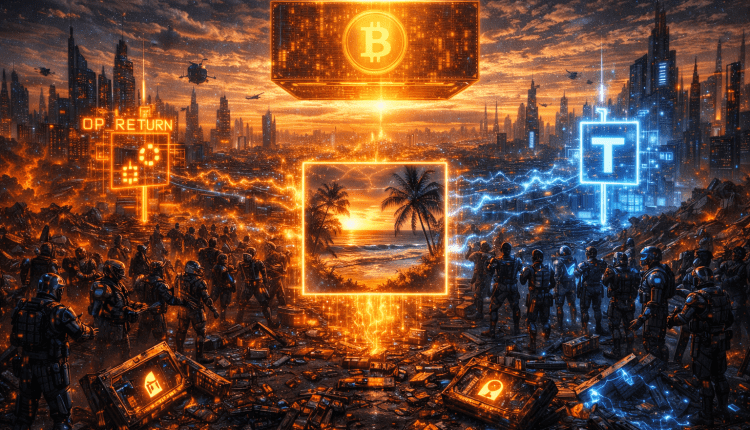
Bitcoin’s long-running fight over inscriptions, spam, and base-layer identity just got a live demo. A developer embedded a 66 KB image into a single Bitcoin transaction without relying on OP_RETURN or the Taproot inscription patterns critics usually target, turning the BIP-110 Bitcoin debate from theory into proof.
A Visual Stunt With Real Governance Consequences
The headline is simple, but the implications are not: Slovak developer Martin Habovštiak embedded a 66-kilobyte image in one Bitcoin transaction, and he did it without using OP_RETURN or Taproot. The transaction remained consensus-valid, and CryptoSlate reported that the bytes can be verified and reconstructed with standard node commands. That matters because it weakens a core anti-spam argument: if one common path is blocked, arbitrary data may simply move to another.
Online advertising service 1lx.online
This is why the story is bigger than “someone put a picture on-chain.” It is really about whether Bitcoin can realistically enforce a money-only social norm through selective technical restrictions, or whether Bitcoin’s scripting flexibility always leaves another door open. In that sense, the new stunt lands directly in the center of the BIP-110 Bitcoin conflict.
Why This Hits the Ordinals War So Hard
The anti-inscription side has argued for months that Bitcoin should reject non-financial data more aggressively. BIP-110’s own abstract says it would “temporarily limit the size of data fields at the consensus level” to correct incentives around arbitrary data and refocus Bitcoin on money. The proposal would, during a temporary one-year deployment, invalidate new output scriptPubKeys over 34 bytes except limited OP_RETURN cases, cap certain witness items and data pushes at 256 bytes, and restrict several Taproot-related constructions.
But Habovštiak’s demonstration is powerful precisely because it appears to sidestep the pathways that dominate public argument. CryptoSlate’s reporting says the construction avoided OP_RETURN and Taproot, while still following consensus rules. That makes the experiment less of an inscription stunt and more of a technical rebuttal: filtering recognized patterns does not necessarily eliminate arbitrary data storage; it may only force more creative encodings.
That is why the BIP-110 Bitcoin debate now looks less like a question of policy cleanup and more like a deeper dispute over what can actually be enforced at the base layer.
Consensus Rules vs Policy Rules — The Real Fault Line
One of the most important points in this story is the distinction between consensus and policy. As outlined in CryptoSlate’s technical framing and in public Bitcoin Core discussion around OP_RETURN policy, consensus rules determine whether a transaction can be mined into a valid block, while policy rules govern what nodes relay by default through the network mempool. If a transaction remains consensus-valid, a miner can still include it, especially through direct submission routes.
That distinction changes everything. Policy can slow behavior, raise costs, or make a method less convenient. It cannot guarantee prevention if miners still have an economic reason to include the transaction. CryptoSlate explicitly framed this as a two-layer system in which filters add friction, not certainty.
This is also why the old OP_RETURN argument keeps resurfacing. In a September 2025 GitHub gist, Bitcoin Core contributor instagibbs argued that the long-standing 80-byte OP_RETURN ceiling had become counter-productive because determined users were already bypassing it, often through more opaque or more harmful encodings. His argument was not that all arbitrary data is good, but that narrow filters can create worse network incentives. Habovštiak’s image demo effectively turns that abstract claim into a concrete public exhibit.
Online advertising service 1lx.online
The Bigger Risk: Another Bitcoin Civil War Over “Spam”
What makes this story especially clickable is that readers do not need to understand script internals to grasp the political point. A single image on-chain becomes a symbolic challenge to the idea that Bitcoin can stay “clean” by closing a few well-known data lanes.
BIP-110 itself is explicit about intent: it argues that arbitrary data storage burdens node operators, competes with payments, and distracts Bitcoin from its function as money. Supporters see that as decentralization defense. Critics see a slippery path toward more subjective filtering, more miner concentration through direct channels, and more governance conflict around what Bitcoin is allowed to be.
That is where this article stops being about Ordinals alone. The real question is whether Bitcoin can police non-financial data without creating an even uglier outcome: more complexity, more centralization, and another exhausting ideological war over protocol identity. On current evidence, the anti-spam thesis looks technically incomplete.
Long-Term Outlook: Bitcoin’s Spam War Just Got a Live Demo
Online advertising service 1lx.online
The most likely outcome is not that one side wins immediately. It is that Bitcoin’s on-chain data debate becomes harder to simplify. Habovštiak’s test does not prove that all restrictions are useless, but it does show that some of the most popular talking points around easy filtering are weaker than they sound.
For BTCNews.space readers, the real takeaway is this: Bitcoin is no longer debating only inscriptions. It is debating enforcement, miner incentives, relay policy, node burden, and the meaning of neutrality at the protocol level. That makes this one of the clearest and most shareable technical governance stories of the week.
For more context on Bitcoin’s broader technical evolution, see our earlier coverage of Bitcoin OP_CAT Revival Could Unlock New Smart Contract Tools Without Changing BTC and Bitcoin DLC Oracles Hint at a New Smart Contract Wave on BTC.
Our creator. Creates amazing NFT collections! Support the editor - Bitcoin_Man(TON) / Bitcoin Man Stickers(TON) / BM Numbers (TON) / Comics Book (TON) / Bitcoin_Man (ETH)
Pi Network (Guide)is a new digital currency developed by Stanford PhDs with over 55 million participants worldwide. To get your Pi, follow this link https://minepi.com/Tsybko and use my username (Tsybko) as the invite code.
Binance: Use this link to sign up and get $100 free and 10% off your first months Binance Futures fees (Terms and Conditions).
Bitget: Use this link Use the Rewards Center and win up to 5027 USDT!(Review)
Bybit: Use this link (all possible discounts on commissions and bonuses up to $30,030 included) If you register through the application, then at the time of registration simply enter in the reference: WB8XZ4 - (manual)