
Bitcoin Miners Are Rewiring for AI as MARA 1GW Deal Signals a New Industry Model
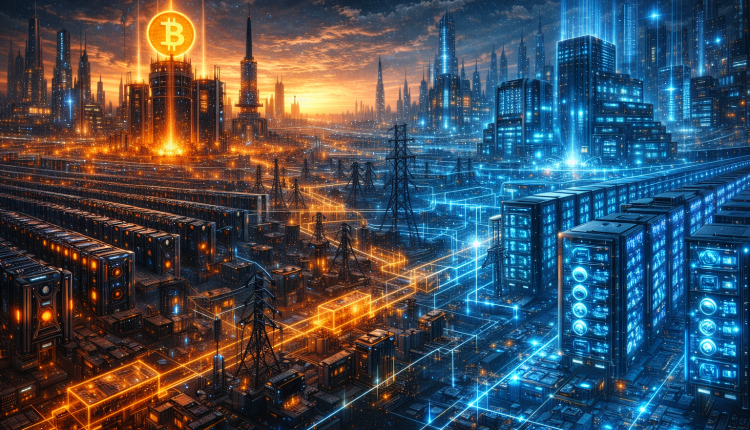
Bitcoin mining is no longer just a hash rate business. MARA new partnership with Starwood suggests the sector is moving into a different identity altogether: miners are becoming power-first digital infrastructure companies that can serve both Bitcoin production and AI-scale compute demand.
The identity crisis of Bitcoin mining is ending
For the last two years, the market treated “mining plus AI” as a diversification story. That framing now looks outdated. MARA said on February 26 that its new platform with Starwood is expected to deliver about 1 gigawatt of near-term IT capacity, with a pathway to more than 2.5 gigawatts, targeting hyperscale, enterprise, and AI-capable digital infrastructure. That language matters because it moves the discussion away from experimental diversification and toward institutional-scale execution.
Online advertising service 1lx.online
At the center of the new model is a cleaner division of labor. MARA brings energized sites, power access, and operating discipline. Starwood Digital Ventures brings design, development, tenant relationships, and institutional credibility in the data center market. In other words, hash rate is no longer the only output miners can monetize. Power, land, grid position, and flexible compute capacity are becoming core products in their own right.
You can see more market structure shifts in our dedicated Mining News section.
MARA Starwood deal shows what the next mining model looks like
MARA official announcement and SEC filing describe a partnership built around large-scale campuses that can support enterprise, hyperscale, and AI demand. The company said the campuses are expected to combine its “energy-backed infrastructure” with Starwood delivery capabilities, and MARA shareholder letter explicitly said the partnership is meant to position the company in the highest-demand segments of the data center market rather than rely only on Bitcoin economics. (sec.gov)
That is the real shift. Bitcoin miners used to be valued mainly on coins mined, fleet efficiency, and treasury strategy. Under this new model, miners can be valued like infrastructure platforms with optionality: run ASICs when mining economics are attractive, lease capacity when AI tenants pay more, and use power access as the scarce strategic asset. This changes the conversation from “Can AI save miners?” to “Are miners becoming the fastest route to new AI capacity?” That is a much more mature and investable thesis.
The market has already seen earlier versions of this transition in our coverage such as Bitcoin Miners Reinvest in Power and AI as Mining Models Evolve and Bitcoin Mining Is Consolidating Faster Than the Market Realizes.
Riot and CleanSpark show this is becoming a sector pattern
MARA is not moving in isolation. Riot announced a 10-year data center lease with AMD at its Rockdale site, starting with 25 MW of critical IT load capacity and expected contract revenue of about $311 million, with extension options that could bring total expected revenue to roughly $1 billion. Riot also said operations on the first phase had already commenced in January 2026, showing that this is not just theoretical pipeline language anymore.
CleanSpark is moving along the same axis from a different angle. In January it announced a land and power expansion near Houston designed to support scaled AI and HPC development, with 300 MW of initial capacity and expansion potential to 600 MW. In its March 5 operational update, the company said it had closed on its second Texas campus, adding 300 MW of ERCOT-approved capacity. This suggests the sector’s most strategic balance-sheet asset is no longer just Bitcoin reserves or machine inventory, but control of large blocks of developable power.
Online advertising service 1lx.online
That is why the old “pivot to AI” label now feels too small. These companies are increasingly positioning themselves as digital infrastructure operators with two monetization lanes: Bitcoin News on one side, AI and HPC tenancy on the other.
Power is becoming more important than pure hash rate
The strongest companies in this new cycle are the ones that already solved the hardest infrastructure problems: land, interconnection, permitting, cooling strategy, and access to large-scale power. AI customers do not necessarily want to wait years for greenfield development. Mining firms already operate in exactly the kinds of locations where large, flexible loads can be brought online faster than traditional data center buildouts.
This gives the industry a new valuation framework. Instead of asking only how many exahashes a miner controls, investors are starting to ask how many megawatts can be converted into higher-value compute. That makes the sector look less like a commodity extraction business and more like an energy-linked real estate and infrastructure business. Barron’s coverage of Riot’s AMD agreement reflected this logic directly, highlighting its Rockdale and Navarro County power footprint as key assets in the AI infrastructure race.
There is also a strategic hedge embedded in the model. When mining margins compress, infrastructure monetization can cushion the downside. When Bitcoin mining strengthens, firms still retain exposure to hash rate economics. That flexibility is exactly why the MARA-Starwood structure matters: it shows a pathway where miners do not have to abandon mining to participate in the AI boom. They can become dual-purpose infrastructure businesses.
Online advertising service 1lx.online
Long-term outlook: ASIC halls may become AI campuses
The biggest implication is psychological as much as financial. The industry used to debate whether miners should diversify away from Bitcoin. Now the more relevant question is whether the best miners are actually becoming the fastest builders of power-dense compute campuses in North America. If that continues, the identity crisis of Bitcoin mining is effectively over.
That does not mean mining disappears. It means mining becomes one workload among several. In this model, a company can mine Bitcoin, host AI inference, support hyperscale deployments, and lease capacity to enterprise tenants, all from the same infrastructure spine. The visual is simple: yesterday’s ASIC warehouse becomes tomorrow’s AI campus. And that may be the clearest sign yet that Bitcoin miners are no longer just miners.
Our creator. Creates amazing NFT collections! Support the editor - Bitcoin_Man(TON) / Bitcoin Man Stickers(TON) / BM Numbers (TON) / Comics Book (TON) / Bitcoin_Man (ETH)
Pi Network (Guide)is a new digital currency developed by Stanford PhDs with over 55 million participants worldwide. To get your Pi, follow this link https://minepi.com/Tsybko and use my username (Tsybko) as the invite code.
Binance: Use this link to sign up and get $100 free and 10% off your first months Binance Futures fees (Terms and Conditions).
Bitget: Use this link Use the Rewards Center and win up to 5027 USDT!(Review)
Bybit: Use this link (all possible discounts on commissions and bonuses up to $30,030 included) If you register through the application, then at the time of registration simply enter in the reference: WB8XZ4 - (manual)