
Ordinals War 2.0: Bitcoin Miners Quietly Split Over Blockspace Control
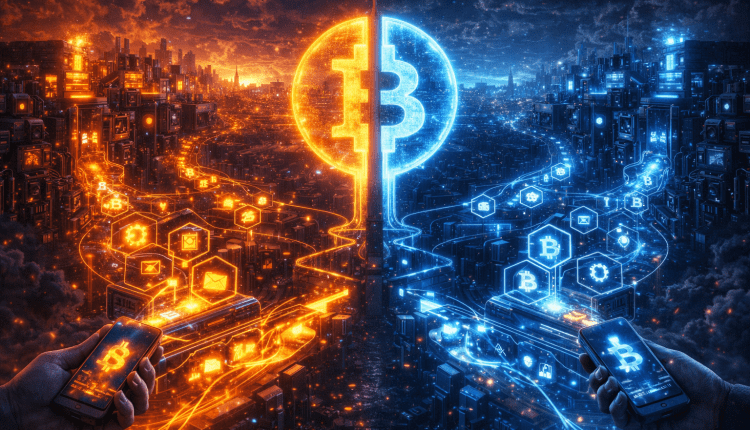
A new conflict is emerging inside Bitcoin — not about price, but about power. Miners are beginning to diverge on whether Ordinals and inscriptions belong in Bitcoin at all, reigniting a deeper debate about who controls blockspace.
A Hidden Civil War Inside Bitcoin
The narrative around Bitcoin Ordinals censorship is evolving fast. What began as a technical experiment has now turned into a structural conflict between miners, developers, and users.
Online advertising service 1lx.online
Some large mining pools are reportedly:
- Filtering or deprioritizing Ordinals transactions
- Adjusting mempool policies
- Signaling preferences for “financial-only” usage
Others continue to include all transactions — regardless of type — arguing for a free market of blockspace.
This creates a silent split inside the network. You can follow similar governance tensions in the Bitcoin News section, where neutrality and control are becoming recurring themes.
Blockspace Is the New Battlefield
At the center of Bitcoin Ordinals censorship is one core question:
👉 Who controls Bitcoin’s blockspace?
There are three competing forces:
Miners
Online advertising service 1lx.online
They decide which transactions get included in blocks.
Filtering gives them direct influence over network behavior.
Users
They pay fees — theoretically shaping demand for blockspace.
Ordinals users argue they are legitimate fee contributors.
Developers
They define protocol rules — but not transaction selection.
Online advertising service 1lx.online
This tension reveals something critical:
Bitcoin governance is not centralized — but it is not neutral either.
The Ideological Divide: Money vs Data
The Ordinals debate is no longer about NFTs.
It’s about Bitcoin’s identity.
Two visions are emerging:
Bitcoin as Money
- Prioritizes financial transactions
- Seeks minimal data usage
- Focuses on efficiency and predictability
Bitcoin as Blockspace Market
- Any valid transaction is acceptable
- Fees determine inclusion
- Innovation happens at the edges
Supporters of Bitcoin Ordinals censorship argue that non-financial data:
- Bloats the chain
- Raises fees for core users
- Distracts from Bitcoin’s purpose
Opponents argue:
- Filtering is censorship
- Neutrality must be absolute
- Miners should not enforce ideology
On-Chain Signals: The Data Tells a Story
According to on-chain analytics (e.g., Glassnode dashboards), blockspace usage patterns are shifting:
- Periods of high inscription activity correlate with fee spikes
- Miner revenue becomes more dependent on non-standard transactions
- Mempool composition reflects changing demand dynamics
These signals suggest that Ordinals are not a fringe phenomenon —
they are economically relevant.
And that makes Bitcoin Ordinals censorship a real, not theoretical, issue.
Why This Matters for Bitcoin’s Future
This conflict goes far beyond inscriptions.
It directly impacts:
- Bitcoin’s neutrality narrative
- Miner incentives in a post-halving world
- The definition of “valid use”
If miners begin filtering transactions at scale, Bitcoin could shift from:
- Permissionless system → to policy-influenced system
This is why developers are raising concerns across forums and GitHub discussions.
A similar structural tension was highlighted in Bitcoin BIP-110 fight is turning into a civil war over what belongs onchain, where governance debates began to intensify.
The Ethereum Contrast: Neutrality vs Programmability
Interestingly, this debate mirrors challenges seen in Ethereum.
While Bitcoin debates Bitcoin Ordinals censorship, Ethereum embraces programmability — even at the cost of complexity.
You can explore this contrast in the Ethereum News section, where infrastructure decisions often prioritize flexibility over strict minimalism.
The difference highlights two philosophies:
- Bitcoin → minimal, neutral money
- Ethereum → programmable, expressive system
Now Bitcoin is being forced to confront that choice.
The Real Question: Who Controls Bitcoin?
The emerging reality is uncomfortable:
👉 Bitcoin is not controlled by a single group —
but influence is shifting.
- Miners control inclusion
- Developers control rules
- Users control demand
And when these interests diverge, conflict is inevitable.
Bitcoin Ordinals censorship is not the end of this debate —
it’s just the beginning of a deeper governance era.
Our creator. Creates amazing NFT collections! Support the editor - Bitcoin_Man(TON) / Bitcoin Man Stickers(TON) / BM Numbers (TON) / Comics Book (TON) / Bitcoin_Man (ETH)
Pi Network (Guide)is a new digital currency developed by Stanford PhDs with over 55 million participants worldwide. To get your Pi, follow this link https://minepi.com/Tsybko and use my username (Tsybko) as the invite code.
Binance: Use this link to sign up and get $100 free and 10% off your first months Binance Futures fees (Terms and Conditions).
Bitget: Use this link Use the Rewards Center and win up to 5027 USDT!(Review)
Bybit: Use this link (all possible discounts on commissions and bonuses up to $30,030 included) If you register through the application, then at the time of registration simply enter in the reference: WB8XZ4 - (manual)