
AI Agents Won’t Ask Banks for Permission — Crypto Payment Rails Are Becoming the Default
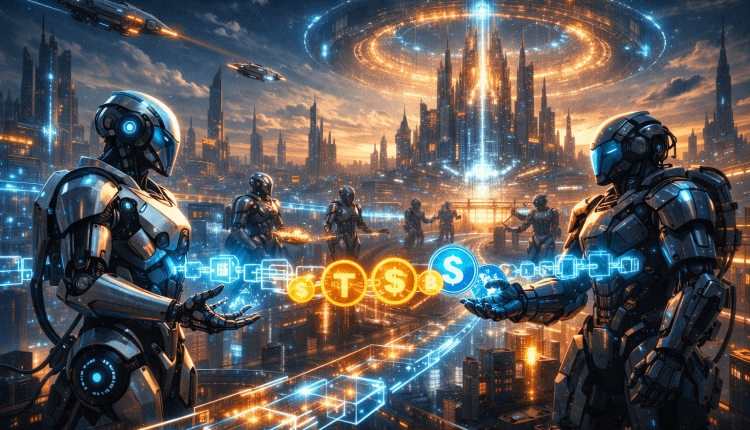
Artificial intelligence is rapidly moving from passive tools to autonomous economic actors.
A growing narrative in crypto now suggests that AI agents may soon become the largest users of blockchain payment infrastructure.
The Rise of Machine-to-Machine Commerce
The idea that AI could transact autonomously is no longer theoretical.
In early March, Binance founder CZ argued that AI agents could soon execute millions of payments — far more than humans — and will naturally rely on crypto rails rather than banks.
Online advertising service 1lx.online
The logic is simple: AI software cannot open bank accounts, pass KYC, or navigate traditional financial infrastructure.
Blockchain payments, however, are programmable, permissionless, and globally accessible, making them an obvious candidate for machine-driven commerce.
This idea is beginning to reshape discussions across the industry, from AI infrastructure providers to stablecoin issuers and Layer-1 blockchain ecosystems.
You can see more developments shaping digital finance in the broader Cryptocurrency News coverage on BTCNews.space.
AI Agents Are Becoming Economic Actors
Projects building AI-native infrastructure are already positioning themselves around this thesis.
NEAR, for example, has recently promoted its ecosystem as “the blockchain for AI.”
The network launched an AI Agent Market, where autonomous agents can theoretically transact with one another — purchasing compute power, data access, or digital services.
This represents a shift from earlier crypto-AI narratives focused on AI tokens and speculation.
Instead, the conversation is moving toward economic infrastructure for machine-to-machine activity.
The trend echoes earlier experiments in decentralized finance.
As reported in previous coverage of AI-driven on-chain systems, autonomous agents are already beginning to manage liquidity strategies and execute DeFi trades without direct human supervision.
More context on that development can be found in our analysis of AI Agents Are Already Managing DeFi Capital — Humans Are Just Watching.
Online advertising service 1lx.online
Stablecoins and Micropayments Could Power the AI Economy
For AI agents to function as economic participants, they require payment rails that support high-frequency, low-value transactions.
This is where stablecoins and crypto payment standards become critical.
Circle’s x402 payment standard, for example, aims to enable machine-to-machine micropayments for APIs, compute services, and digital infrastructure.
Instead of relying on subscriptions or billing systems designed for humans, AI agents could pay directly per request or per service call.
In such a system, an AI model might:
Online advertising service 1lx.online
- Pay another AI agent for training data
- Purchase compute power on demand
- Pay for API access to external services
- Compensate content providers in real time
Traditional financial rails are poorly suited for these use cases due to settlement delays, fees, and regulatory friction.
Blockchain rails, by contrast, offer instant settlement and programmable payments.
The Real AI-Crypto Narrative May Be Payments
For years, crypto markets focused on AI-themed tokens, many of which promised decentralized machine intelligence but delivered little real adoption.
The emerging narrative is far more practical.
Instead of AI projects issuing tokens, the real transformation could come from AI using existing crypto infrastructure to transact autonomously.
This reframes crypto’s role in the AI economy:
- not as speculation around AI tokens
- but as financial plumbing for autonomous digital economies
It also connects directly with the broader evolution of blockchain infrastructure, where networks increasingly compete to become the default settlement layers for programmable economic activity.
Developments in smart contract ecosystems such as Ethereum News suggest that programmable finance remains a central component of this infrastructure race.
Long-Term Outlook: A Machine Economy on Crypto Rails
If AI agents begin to transact at scale, the implications for blockchain adoption could be significant.
Unlike human users, autonomous software can execute millions of micro-transactions per day, creating entirely new forms of economic activity.
That could dramatically increase demand for:
- stablecoin settlement layers
- high-throughput blockchains
- decentralized compute marketplaces
- automated on-chain payment infrastructure
In that scenario, the biggest blockchain users of the future might not be traders or retail investors.
They might be machines paying other machines.
And in that economy, permissionless payment networks could become the default financial rails.
Our creator. Creates amazing NFT collections! Support the editor - Bitcoin_Man(TON) / Bitcoin Man Stickers(TON) / BM Numbers (TON) / Comics Book (TON) / Bitcoin_Man (ETH)
Pi Network (Guide)is a new digital currency developed by Stanford PhDs with over 55 million participants worldwide. To get your Pi, follow this link https://minepi.com/Tsybko and use my username (Tsybko) as the invite code.
Binance: Use this link to sign up and get $100 free and 10% off your first months Binance Futures fees (Terms and Conditions).
Bitget: Use this link Use the Rewards Center and win up to 5027 USDT!(Review)
Bybit: Use this link (all possible discounts on commissions and bonuses up to $30,030 included) If you register through the application, then at the time of registration simply enter in the reference: WB8XZ4 - (manual)
Related guide: Learn how autonomous systems use wallets, protocols, and on-chain services in our overview, Understanding AI Agents in Crypto.